
 I am now in Cambodia. To be honest this is a country I was unsure about, probably because I associated it with its terrible recent history. Between 1976 and 1978 3 million people, nearly 25% of the population, were murdered by the communist Khmer Rouge government. 90% of the country’s wealthy and educated elite were targeted and killed. Cambodia is steadily overcoming this trauma but is a country with nearly half of its population under 24.
I think I felt subconsciously that this horror would make this a sad place. How wrong I was! From the moment I arrived at the airport I was overwhelmed by the warmth and friendliness of the people. When passing through Border Control, it transpired that I had the wrong entry visa. I feared that I would be arrested and deported. Instead a super friendly policeman escorted me to the visa desk, helped me fill in the correct forms then walked me back to the Border Control queue… You sure wouldn’t get that at Gatwick.
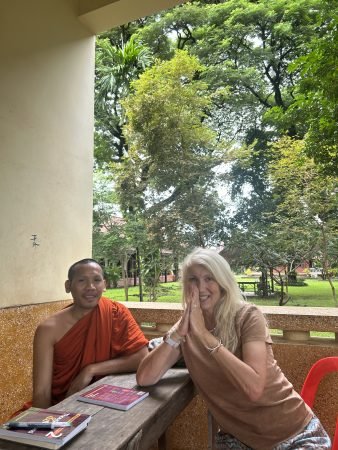
My voluntary project here is teaching English to Buddhist monks and community groups. I felt that this work would give me a greater understanding of the Buddhist religion and I might return to Lingfield a bit more ‘Zen.’ A personality change which, I knew, would be greatly appreciated by my friends and family.
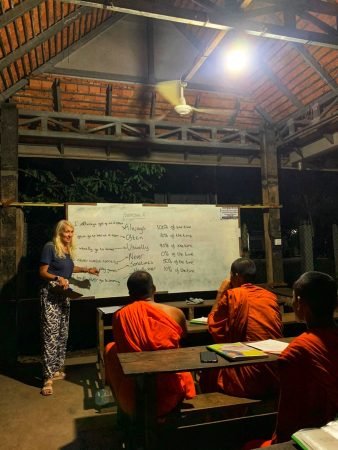 The first morning I stood up in front of a group of young Buddhist monks in a temple, only armed with a white board, marker pen and text book, I was very nervous. However my initial fears were totally unfounded. The monks are the most charming, respectful and enthusiastic bunch and their thirst for knowledge is extraordinary. They go to Buddhist school for 8 hours a day and attend high school or university for a further 3 hours a day. This is after rising at 5am to chant for an hour and eating no food after 12 noon.
Young men usually become monks to gain a good education and have a place to live. This is clearly the main motivating factor rather than any religious calling. Once they have attained their degrees they often leave the temple and get jobs and marry. Whilst they are not allowed to play any sport, drink alcohol or ride motorbikes, they all have mobile phones, wear fake designer sunglasses and drink takeaway coffees.
At the outset I was given strict guidelines on dressing modestly and told that I must never point at monks or touch them. Trying to get a monk to answer a question when you can’t pronounce his name and can’t point is tricky. I have developed an odd scooping gesture with my hands, as a pointy finger replacement. What stands out is their passion for learning the English language and pronouncing words properly. I fear that there will be a group of monks, when I leave, who will be speaking great English but with Brummie accents…
